Space size comparison
The Sun, the planets, the Moon and giant stars, drawn to scale. Diameters from NASA.
Space size comparison: the tool

Every size on this page
17 space, from Ceres (952 km (592 mi)) to M87* black hole (40,000,000,000 km (24,854,847,689 mi)). Add any of them to the board from the list.
| What | Size | Source |
|---|---|---|
| M87* black hole Event horizon just under 40 billion km across; its shadow is about 2.5 times larger. | 40,000,000,000 km (24,854,847,689 mi) across | European Southern Observatory |
| UY Scuti Radius estimates differ with distance: 1,708 solar radii (2013), about 755 (Gaia DR2), 909 (Healy et al. 2023). Value uses 909, converted with the NASA solar radius. | 1,264,783,000 km (785,899,721 mi) across range 1,050,507,000 km (652,754,787 mi) to 2,376,511,000 km (1,476,695,473 mi) | Wikipedia |
| Betelgeuse Radius 764 solar radii, uncertainty range 702 to 880 (Joyce et al. 2020), converted with the NASA solar radius. The star varies and estimates differ. | 1,063,030,000 km (660,536,218 mi) across range 976,762,800 km (606,932,266 mi) to 1,224,432,000 km (760,826,772 mi) | arXiv / The Astrophysical Journal |
| Sagittarius A* black hole Twice the Schwarzschild radius of 12 million km. The bright ring seen by the EHT measures 51.8 microarcseconds across, larger than the event horizon. | 24,000,000 km (14,912,909 mi) across | NASA Jet Propulsion Laboratory, Wikipedia |
| Sirius A Radius 1.713 solar radii (interferometry), converted with the NASA solar radius of 695,700 km. | 2,383,468 km (1,481,018 mi) across | arXiv / The Astrophysical Journal |
| Sun Twice the volumetric mean radius of 695,700 km. | 1,391,400 km (864,576 mi) across | NASA NSSDC |
| Jupiter Equatorial diameter. | 142,984 km (88,846 mi) across | NASA NSSDC |
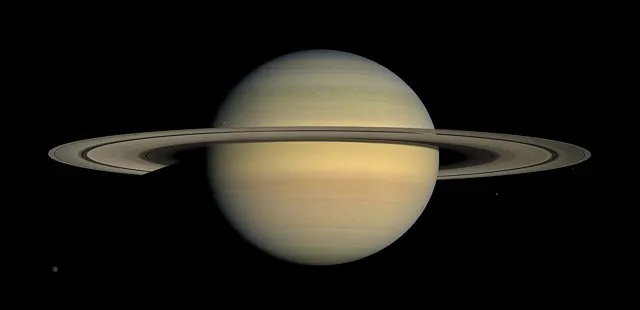
| Saturn Equatorial diameter. | 120,536 km (74,898 mi) across | NASA NSSDC, NASA NSSDC |
| Uranus Equatorial diameter. | 51,118 km (31,763 mi) across | NASA NSSDC |
| Neptune Equatorial diameter. | 49,528 km (30,775 mi) across | NASA NSSDC |
| Earth Equatorial diameter. | 12,756 km (7,926 mi) across | NASA NSSDC |
| Venus Equatorial diameter. | 12,104 km (7,521 mi) across | NASA NSSDC |
| Mars Equatorial diameter. | 6,792 km (4,220 mi) across | NASA NSSDC |
| Mercury Equatorial diameter. | 4,879 km (3,032 mi) across | NASA NSSDC |
| Moon Diameter. | 3,475 km (2,159 mi) across | NASA NSSDC |
| Pluto Equatorial diameter. | 2,376 km (1,476 mi) across | NASA NSSDC |
| Ceres Twice the stated radius of 476 km. | 952 km (592 mi) across | NASA Science |
Closer comparisons
Drawings are to scale on the measured dimension. The other proportions of each silhouette are approximate.
Related tools
Sources
- NASA NSSDC: Sun Fact Sheet (checked 2026-10-02)
- NASA NSSDC: Planetary Fact Sheet (checked 2026-10-02)
- NASA NSSDC: Saturnian Rings Fact Sheet (checked 2026-10-02)
- NASA Science: Ceres: Facts (checked 2026-10-02)
- arXiv / The Astrophysical Journal: The Angular Diameter and Fundamental Parameters of Sirius A (Davis et al.) (checked 2026-10-02)
- arXiv / The Astrophysical Journal: Standing on the shoulders of giants: new mass and distance estimates for Betelgeuse (Joyce et al. 2020) (checked 2026-10-02)
- Wikipedia: UY Scuti (via Wikipedia, citing Arroyo-Torres et al. 2013 and Healy et al. 2023) (checked 2026-10-02)
- European Southern Observatory: Astronomers Capture First Image of a Black Hole (eso1907) (checked 2026-10-02)
- NASA Jet Propulsion Laboratory: Telescopes Get Extraordinary View of Milky Way's Black Hole (checked 2026-10-03)
- Wikipedia: Sagittarius A* (via Wikipedia) (checked 2026-10-02)
- arXiv / The Astrophysical Journal Letters: First Sagittarius A* EHT Results. I. The Shadow of the Supermassive Black Hole (checked 2026-10-02)
Last checked: 5 October 2026